What Are Rhinestone Sizes?
Rhinestone sizes are measured in ss, which stands for Stone Size. The ss system is the universal standard for flatback rhinestones. Larger ss numbers mean larger stones. This guide covers every common size from ss3 through ss50 with visual references, millimeter measurements, and project recommendations.
A practical rule: ss3 through ss9 are micro sizes for nail art and fine detail. ss10 through ss16 are small to mid-range, great for apparel and accessories. ss20 is the most popular all-purpose size. ss30 and above is statement-level sparkle visible at stage distance.
Visual Size Reference
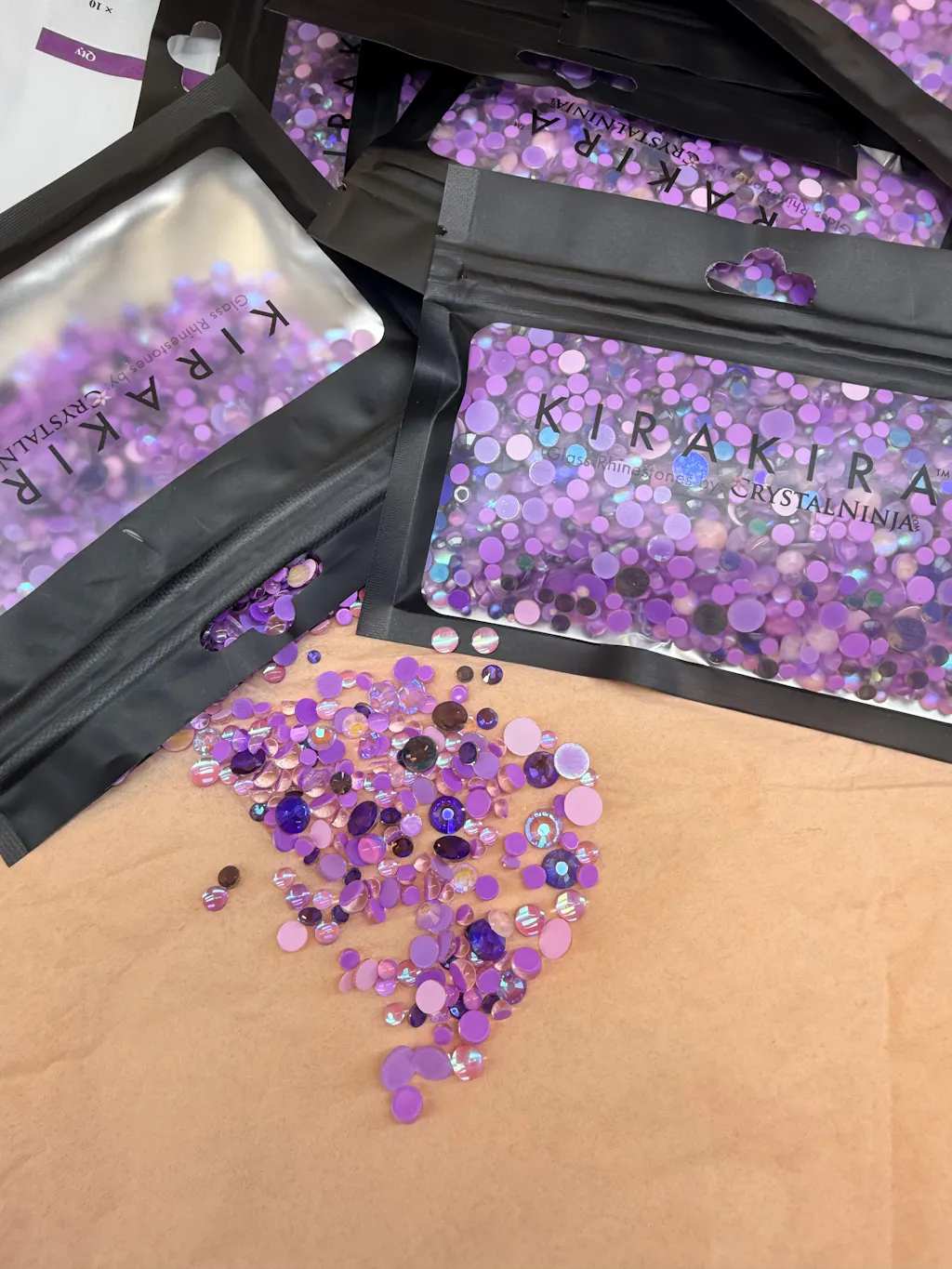
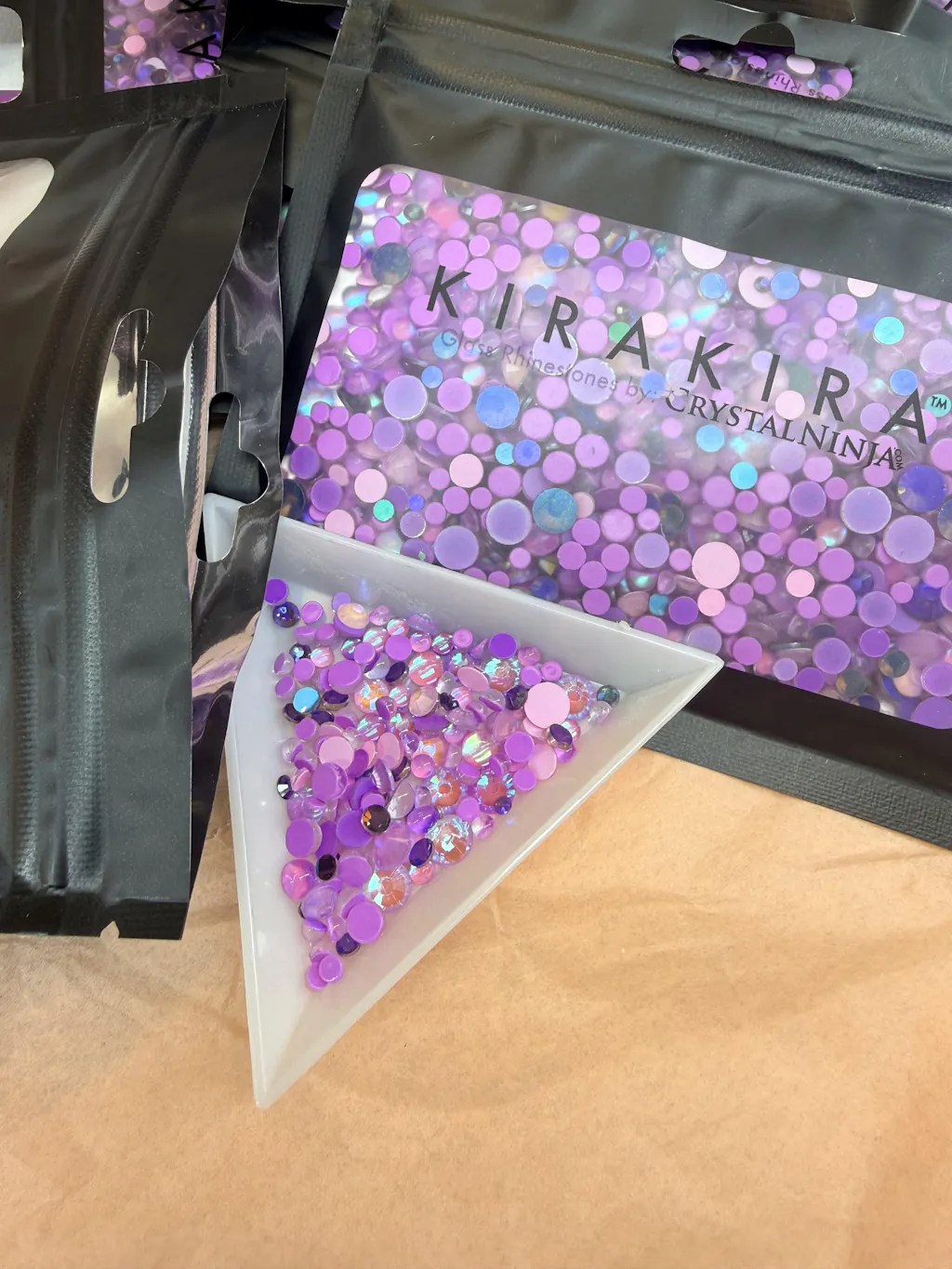
Each card below shows a KiraKira rhinestone at that size, along with its millimeter and inch measurements.
Micro Sizes (ss3 through ss9)


Micro sizes are standard for nail art and intricate detail work. ss5 and ss6 are the most popular nail art sizes. These tiny stones require a precision pick-up tool like the Crystal Katana for accurate placement.
Small to Mid-Range (ss10 through ss16)


ss10 bridges the gap between nail art and apparel. ss12 is popular for fine fabric accents and lettering. ss16 is one of the most versatile mid-range sizes, perfect for phone cases, tumblers, and small accessories.
All-Purpose (ss20)

ss20 is the most popular all-purpose rhinestone size. It works on nearly everything: tumblers, shoes, apparel, bags, and home decor. This is the size most artists start with and the one we recommend for beginners.
Large and Statement Sizes (ss30 through ss50)


Large stones create bold, dramatic sparkle. ss30 and ss34 are the go-to for stage costumes, dance wear, and competition pieces because they catch light at a distance. ss40 and ss50 are statement stones used for focal points, center accents, and high-impact areas.
Size Chart
| ss Size |
Diameter (mm) |
Approx.
Stones per sq in |
Best For |
| ss3 |
1.3-1.4mm |
~378 |
Micro nail art, pixelated designs |
| ss4 |
1.5-1.6mm |
~279 |
Nail art, tiny accent details |
| ss5 |
1.7-1.8mm |
~224 |
Nail art, fine detail work |
| ss6 |
1.9-2.0mm |
~175 |
Nail art, miniature designs |
| ss7 |
2.1-2.2mm |
~143 |
Nail art, small accent fills |
| ss8 |
2.3-2.5mm |
~120 |
Nail art, fine apparel detail |
| ss9 |
2.5-2.7mm |
~99 |
Transition size, nail art, tiny fills |
| ss10 |
2.7-2.9mm |
~85 |
Intricate designs, lettering, detail fill |
| ss12 |
3.0-3.2mm |
~68 |
Nail art, fine fabric accents, lettering |
| ss14 |
3.4-3.6mm |
~52 |
Apparel details, small accessories |
| ss16 |
3.8-4.0mm |
~42 |
T-shirts, phone cases, accessories, tumblers |
| ss20 |
4.6-4.8mm |
~27 |
Tumblers, shoes, apparel, general bling |
| ss30 |
6.3-6.5mm |
~12 |
Statement pieces, stage costumes, bags |
| ss34 |
7.0-7.2mm |
~9 |
Focal points, center stones, banding |
| ss40 |
8.5-8.8mm |
~6 |
Bold accents, large focal points |
| ss50 |
9.5-10.0mm |
~4 |
Maximum impact, center gems, car bling |
Which Size Should You Use?
Tumblers and Drinkware
ss16 and ss20 are the most popular tumbler sizes. They pack tightly, create consistent sparkle, and hold well with resin adhesive. ss10 can be used for intricate patterns or lettering on smaller cups.
Stage Costumes and Dance Wear
Go big. ss30 and ss34 are designed to catch light from stage distance. The standard for competitive dance and performance is to use at least ss20, with ss30 accents at focal points like collars, cuffs, and center fronts.
Nail Art
ss3 through ss9 are the standard nail sizes. ss5 and ss6 are the most popular. Some nail artists mix ss3 for pixelated detail with ss8 or ss9 for accent stones. Glued flatbacks with UV resin gel give the longest wear on nails.
Apparel and Accessories
ss16 and ss20 are the workhorses for t-shirts, jackets, hats, and bags. ss10 and ss12 work well for lettering and fine details. For bold accents, mix in ss30 stones at center points.
Home Decor and Resin Projects
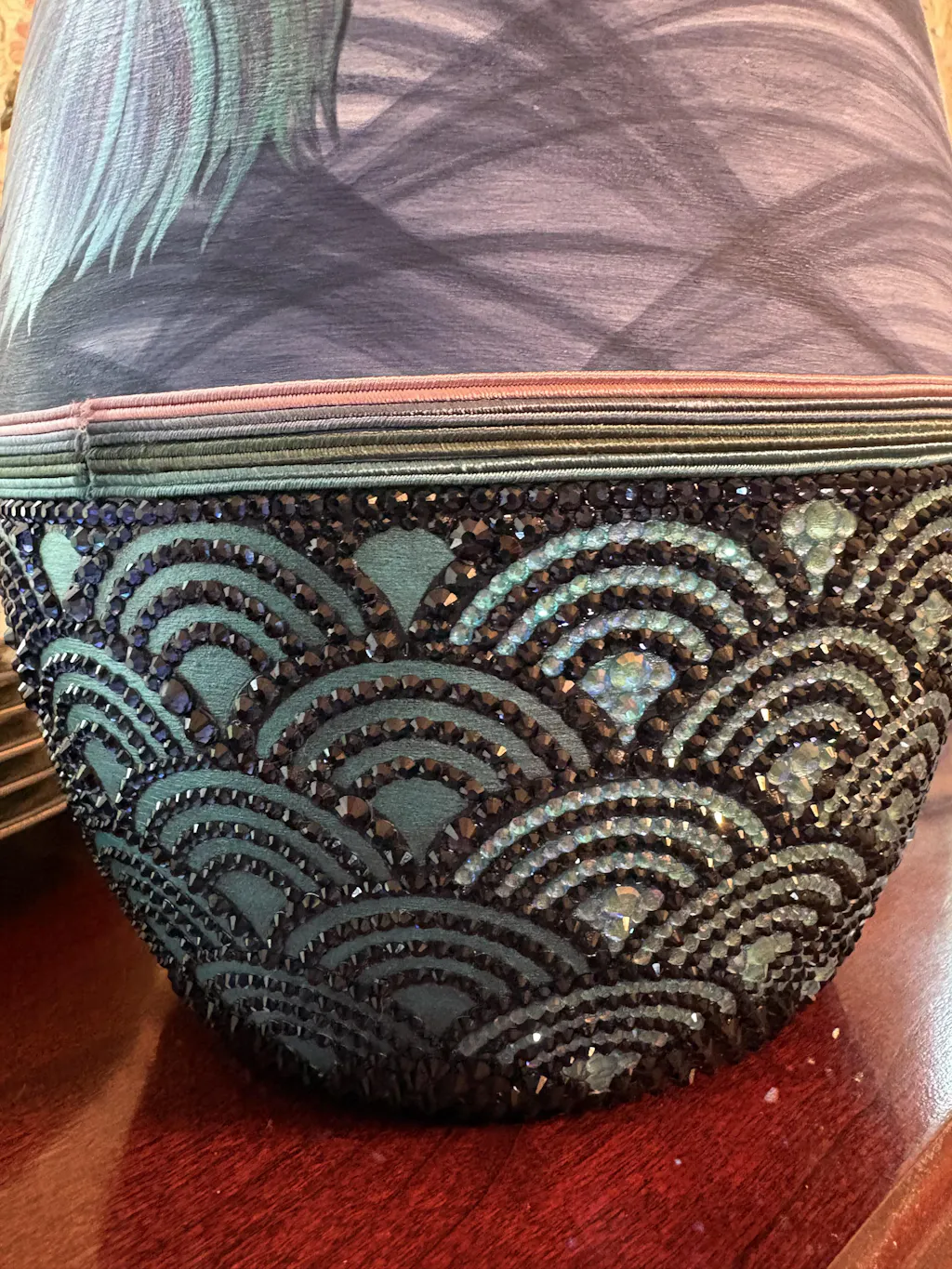
ss20 through ss30 create dramatic results on frames, mirrors, and decorative objects. The larger the surface, the larger the stone you can use without losing proportion.
Cars and Large Surfaces
Car bling projects use a mix of sizes. ss20 for base fills, ss30 and ss34 for main panels, and ss40 or ss50 for center focal points. See our bedazzled cars guide for more.
The Fun Side of Rhinestone Sizes
Rhinestone sizes can feel abstract until you compare them to everyday objects. Here are some real-world comparisons that make each size click instantly.
Real-World Size Comparisons
ss3 (1.3mm) is about the size of a single grain of sand. You could line up 19 of them across a single penny. These are the tiniest sparkle you can place, and nail artists love them for pixelated detail work.
ss6 (2.0mm) is roughly the size of a poppy seed. Small enough for fine detail, but big enough to catch light from arm's length. This is the go-to for nail art professionals.
ss10 (2.8mm) is about the size of a sesame seed. This is where rhinestones start transitioning from detail work to design fill. Perfect for lettering and small motifs.
ss16 (4.0mm) is close to a single lentil. This is the workhorse size for tumbler artists and apparel designers. Big enough to see from across a room, small enough to pack tightly for full coverage.
ss20 (5.0mm) is roughly the diameter of a standard pencil eraser. The most popular all-purpose rhinestone size in the industry. If you could only pick one size, this is the one most artists would choose.
ss30 (6.5mm) is about the size of a pea. Stage performers use this size because it catches spotlight from 50 feet away. Competitive dancers swear by ss30 for maximum stage sparkle.
ss40 (8.5mm) is close to a blueberry. These are statement stones. One ss40 has more surface area than four ss20s combined, and it throws light like a tiny disco ball.
ss50 (11mm) is about the diameter of a dime. These are the largest standard flatback size and are used as center focal gems on costumes, crowns, and car hoods.
Quick Math That Might Surprise You
It takes approximately 6 ss3 rhinestones lined up to equal the width of one ss20. But in terms of area, you could fit roughly 15 ss3 stones inside the footprint of a single ss20.
A standard 20oz tumbler covered in ss16 uses around 2,500 rhinestones. If you stacked all those stones on top of each other, the tower would stand about 33 feet tall. That is taller than a two-story house.
The surface area of one ss50 rhinestone is about the same as 71 ss3 rhinestones combined. Big stones are not just bigger. They are exponentially bigger.
How Rhinestone Sizes Got Their Names
The "ss" stands for Stone Size, and it comes from the European gemstone grading system. Originally, these numbers referred to a specific sieve size used to sort natural gemstones by diameter. When flatback rhinestones became popular in the fashion and costume industry, the same numbering system carried over. That is why the numbers do not increase evenly. ss3, ss5, ss7, ss10, ss12, ss16, ss20, ss30 are all standard sizes because they match the original sieve gauge intervals.
Pro Tips From 20+ Years of Rhinestone Experience
Mixing sizes is the secret to professional-looking work. Real crystal artists rarely use just one size. A tumbler design with ss20 as the main fill, ss16 around curves, and ss10 for lettering looks polished and intentional. Stage costumes layer ss30 focal stones with ss16 fill and ss10 detail accents.
Bigger is not always better. Smaller stones actually create a more "diamond-like" sparkle because they refract light at more angles per square inch. A field of ss10 shimmers. A field of ss30 flashes. Both are beautiful, and the right choice depends on viewing distance.
The 3-size rule: For any project, pick a primary fill size, one size smaller for detail and transitions, and one size larger for accents. This gives depth and dimension to any design, whether it is a tumbler, a jacket, or a pair of dance shoes.
How to Count Rhinestones Per Project
Estimate coverage by measuring your design area in square inches, then multiplying by the stones-per-square-inch figure from the table above. Add 10% for waste and placement adjustments.
For a full standard 20oz tumbler, expect to use approximately 3,300-3,500 stones in ss16, or 2,300 to 2,600 stones in ss20. Most artists need 2 packs of KiraKira ss16 (each pack is 1,440 stones, sold as 10 gross) for full tumbler coverage.
KiraKira rhinestones are sold in 10-gross packs (approximately 1,440 stones), which covers most single-project needs for medium and small stones.
Access the Rhinestone Ruler APP with your membership in the SPARKLER! area of www.RhinestoneArtist.com to estimate stone counts for any project size and pattern.

Written by Kellie DeFries, founder of CrystalNinja. 20+ years of professional rhinestone application experience. Inventor of the Crystal Katana (5 US patents).