Let me tell you about the week a $4.5 million hypercar rolled into my studio and asked to be covered in crystal. All of it. This is the Aston Martin Valkyrie, and when we finished, it became the world's first bedazzled hypercar.
A brand activation, not a craft project
This was a luxury brand activation for Supercar Ron. The goal was his social media: grow the views, grow the following. It did exactly that. It doubled his subscriber count, went viral, and a year later it is still going viral. We were honored to be asked, and we delivered something nobody had ever seen.
What went on the car
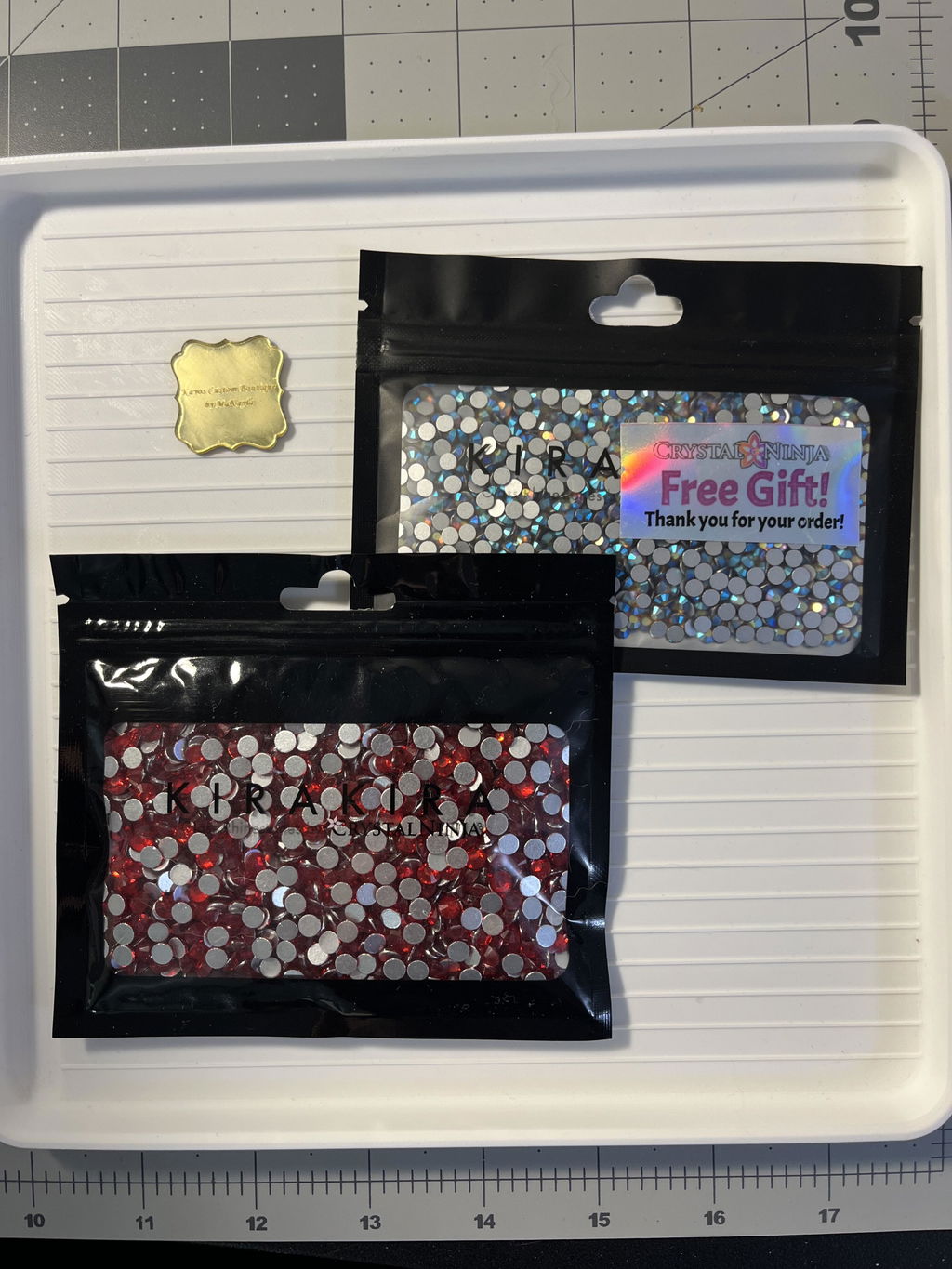
Here is a fact I am proud of: this hypercar is 95% KiraKira glass rhinestones. My own line, the same stones I sell in the shop, covering a $4.5 million Aston Martin. Then we accented the emblems and logos in Swarovski, including 24k gold Swarovski from my personal collection that I acquired back in 2008. Each of those tiny SS7 gold stones is valued at $48. Apiece. On the emblems, you are looking at gold-flecked crystal worth more per stone than most people spend on a whole craft project.
The problem: 300,000 stones, many hands, eight days
A project this size cannot be a solo job. We had a few of our Certified Ninjaneers on deck, alongside a crew of volunteers, all working shoulder to shoulder. And that is where the real challenge lives. My usual sprinkle and scatter fill patterns depend on one artist's spacing, rhythm, and eye. Put a whole team on a car with that method and you get a dozen different looks. On a $4.5M vehicle, inconsistency is not an option.
What I invented for this car
So I built something that had never been done: a four-layer transfer pass that keeps the entire surface perfectly consistent no matter how many hands are working.
We laid it in three graduated layers of KiraKira glass first: SS16 (four millimeter), then SS20 (five millimeter), then SS30 (six millimeter). Once those three layers were down, we came back with larger shapes to fill. The whole thing ran on transfers. One team built the transfers on site. Another crew glued the back of every stone on those transfers. Then they handed them to us at the car, where we placed everything. A relay line of specialists, feeding a consistent, flawless surface.
Ten people, give or take, every day. Twelve hours a day. Eight days. And I have to say it: our Certified Ninjaneers and our volunteers all did such a great job working together. Watching that team move as one, on a project with zero room for error, is something I will never forget.
Why this one is elite
This project was massive, expensive, and elite. It took ferociously fast thinking on site, and it took my twenty years of practice all lined up in a single row, firing at once. Nobody had ever crystallized a hypercar before. We did it in eight days because of the process I invented to make it possible. I am deeply proud of this one, and of every person who touched it.
Want the full breakdown?
The complete process, every step of how we did it, is available as a course at bedazzledcar.com, and we may even offer a kit so you can learn to do your own. Contact us for a quote.
And if you want to work with the same KiraKira glass rhinestones that covered a hypercar, they are in the shop. Reach us at crystalninja.com to shop the line or to talk about a luxury activation of your own.